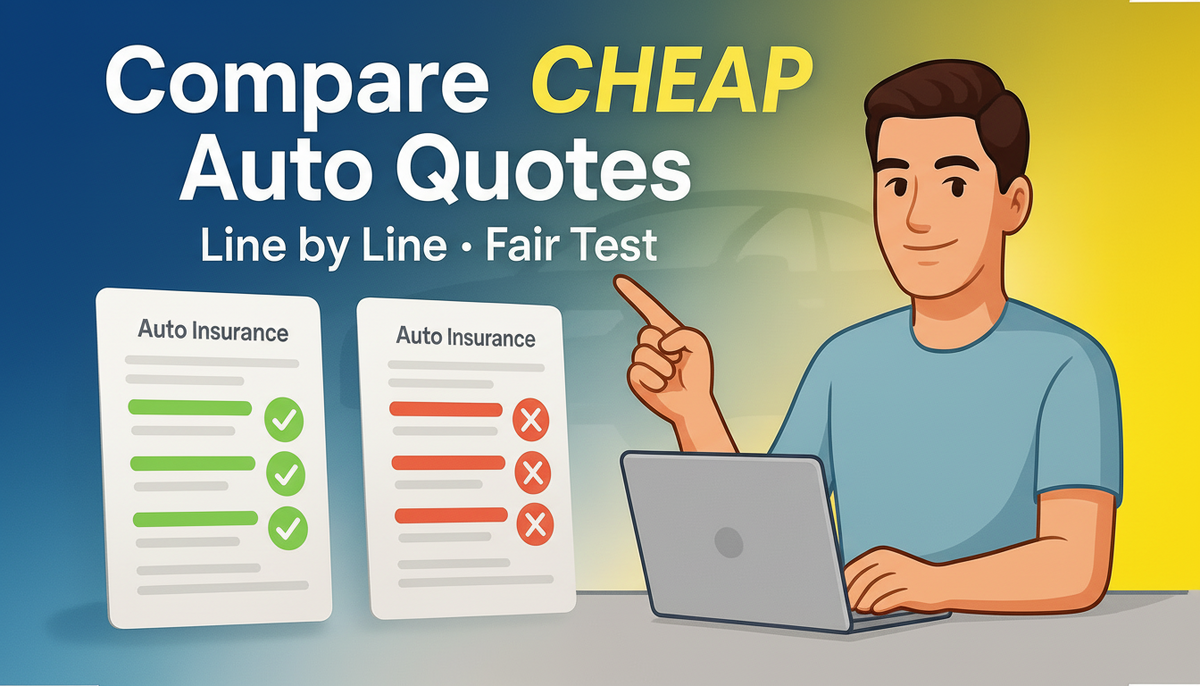
Two “cheap auto insurance” quotes can be different products wearing the same price tag. One might look low because it trims liability limits, drops uninsured motorist, or bumps the deductible. The other might cost a bit more but actually pays when something goes wrong.
When I want to get a car insurance quote without getting burned later, I don’t hunt for the lowest number first. I make every quote identical, then compare it line by line. Below is the exact checklist I use for affordable car insurance so I don’t miss coverage details that can turn into surprise costs after a claim.
My 10-minute setup to compare quotes fast (before I click “buy”)
Speed comes from consistency. I set up one “source of truth” for my personal information and auto insurance policy inputs, then I reuse it for every insurer so the quotes come back comparable. If I change one variable by accident, like annual mileage or coverage start date, I can’t trust the price difference.
Before I start, I gather what I’ll need and keep it in one note. I also try to run all quotes the same day because prices move quickly, sometimes within hours.
The exact info I keep the same for every quote
These are the fields I lock down and repeat, exactly, every time:
- Driver names and date of birth
- License status (valid, suspended, international, new driver)
- Credit score
- Marital status (some carriers price this differently)
- Address and garaging ZIP code (where the car sleeps at night)
- Commute miles and commute days per week
- Annual mileage (don’t “round” differently on each site)
- Vehicle details: VIN, trim, engine, usage
- Ownership: own, finance, or lease (and lienholder if financed)
- Policy start date (I use the same date across all quotes)
- Current insurer and prior limits (if asked)
- Continuous coverage history (gaps matter)
- Accidents, claims, tickets with dates (month and year) that reflect your driving history (even with a clean driving record)
- Student, military, homeowner status (only if asked)
Quick tip that saves me time: if a form forces a guess (like exact annual miles), I write down the guess and use the same number everywhere, including the precise ZIP code. The goal is fairness, not perfection.
How I capture car insurance quotes so I can compare them line by line
I open 2 to 4 online quotes from different insurance companies in separate tabs. When I reach the coverage page on the online quote, I screenshot it and download the quote PDF if it’s offered. Then I copy the important numbers into one place (a note or a basic spreadsheet works).
Here’s what I record every time:
What I recordWhy it mattersCompany nameObvious, but easy to mix up between insurance companiesQuote date and timePrices can change fastTerm length (6 or 12 months)You can’t compare different terms without convertingTotal premium for the termThe real costMonthly paymentOnly useful with fees and down paymentDown payment requiredSome “cheap” plans hide a big upfront billInstallment or policy feesCan erase a price winQuote ID or reference numberHelps if I call to confirm details
I never compare a 6-month quote to a 12-month quote at face value. If I have to, I convert them to the same term (and I still prefer getting matching term quotes instead).
The line by line checklist that makes it a fair test
This is the part that makes cheap quotes honest. I scan each quote and confirm that each coverage line matches. If something is missing or different, I adjust it before I judge the price.
When a claim happens, the “small print” becomes the whole story. These are the lines that most often cause bad surprises.
Liability limits: I match the numbers, not the labels
Liability coverage is what pays for injuries or damage you cause to other people. Most quotes show it as:
- Bodily injury (per person / per accident)
- Property damage
Some sites label options as “minimum coverage,” “basic,” or “standard.” Those labels don’t help me. I match the exact limits of liability coverage.
A simple rule I follow: if two quotes have different liability coverage limits, the cheaper one is not really cheaper.
One more detail: some insurers show a split limit (like 100/300), while others may show a combined single limit. Those can be made equivalent, but they aren’t automatically comparable. I pick one style and keep it consistent across quotes.
Deductibles and coverage types: comprehensive, collision, and full glass
Next, I make full coverage match. This is where quotes often “cheat” without saying so.
I line up the car insurance deductibles:
- Collision coverage deductible (common mismatch: $500 vs $1,000)
- Comprehensive coverage deductible (often set lower without you noticing)
- Glass options (full glass, $0 glass, or a separate glass deductible)
I also check that both quotes include collision coverage and comprehensive coverage at all. Sometimes a cheap quote is cheap because collision coverage was removed. That’s not a bargain, it’s a different policy.
Two add-ons that can swing the total more than people expect are roadside assistance and rental reimbursement. I either match roadside assistance on both quotes or remove it on both quotes. Mixed settings make the comparison meaningless.
Uninsured motorist coverage and underinsured motorist: the sneaky difference in “cheap” quotes
Uninsured motorist coverage (UM) and underinsured motorist (UIM) help protect me if another driver causes the crash and doesn’t have enough insurance, or has none at all. Even when a state doesn’t require it, dropping UM or UIM can make a quote look cheaper while raising my risk.
When I compare, I match UM and UIM limits to the same numbers across quotes. If the form allows it, I usually try to keep them close to my liability limits so the protection is consistent.
If I see “stacked” versus “non-stacked,” I make sure I’m comparing the same option. Stacked coverage can cost more, but it can also pay more, so it needs to be an apples-to-apples choice.
Hidden price traps: what I double check so the lowest quote stays the lowest
Even after coverage matches, the bill can still be misleading. The quote might assume payment choices or discounts that won’t actually stick.
This is the part I check so the low price doesn’t jump after the first bill.
Term length, payment plan, fees, and required down payment
A cheap monthly premium can hide a bigger down payment or extra fees. I compare:
- Same term length (6 months vs 12 months)
- Paid in full vs monthly installments
- Installment fees
- Policy fees
- Whether autopay is required for the shown price
My rule: I compare total cost of the auto insurance policy for the full term first. If I need a monthly premium, I divide after I know the real term total.
Discounts and assumptions: I verify what is actually included
Quote forms love assumptions. I look for discounts listed as “applied” versus “available,” and I confirm I qualify.
Common discounts that get assumed:
- bundling auto and home
- multi-vehicle discounts
- Homeowner (even without bundling)
- Safe driver
- Good student
- Defensive driving course
- safety features
- Paperless billing
- Autopay
- Paid in full
- Telematics or app tracking
Telematics is a big one. Some quotes include a tracking program by default to monitor your driving habits, potentially offering discounts for safe driving. The price can change after a trial period based on those driving habits. If I don’t want my safe driving monitored, I remove it from every quote before I compare.
My quick decision rules after I quote cheap auto insurance from several insurance companies
Once everything matches, I stop shopping the tiny differences. I want the best value, not the most stressful policy.
When I quote cheap auto insurance across several insurance companies, I use a simple way to pick without overthinking.
I pick the winner using total cost, claim support signals, and deal breakers
First, I choose based on the same coverages, same term, and a deductible I can live with. Then I look for a few quick signals from these insurance companies:
- Claims access: 24/7 claims line, solid app, clear next steps in the claim process after an accident
- Repair process: smooth claim process with ability to choose a shop, a reasonable network if they push one
- Complaint signals: I do a quick search for patterns (billing issues, claim delays, or how tickets exclude high-risk drivers from the lowest rates), not one-off rants
- Financial strength: if I can find it fast from a reputable rating source, I check it
My deal breakers are simple: missing key coverage, odd exclusions I can’t explain, a huge down payment, or a price that depends on a tracking program I don’t want.
My final check before I buy: what I confirm in writing
Right before I bind coverage online or with an insurance agent, I confirm these items on the final screen or in the quote PDF:
- Drivers and vehicles are correct (names, VIN, trim)
- Coverage start date matches my plan
- Lienholder is listed if I finance or lease
- Liability coverage limits and deductibles match my comparison sheet and meet state requirements
- Discounts show as applied (not just “available”)
- The final bind price matches the car insurance quote (including fees)
Then I save the quote PDF (or screenshots), the declarations page after purchase, the cancellation steps for my old policy, and my insurance agent contact info if applicable. That helps me avoid a coverage gap, which can raise rates later.
Conclusion
The fastest way to compare car insurance rates is simple: make them identical, then check a short list line by line. Cheap only counts when the coverage and the real total cost match. Gather your info, run 3 to 5 quotes the same day, fill in your checklist, then choose the winner based on total term cost and your deal breakers. If you do it this way, a car insurance quote for cheap auto insurance stops being a gamble and starts being a clean, fair test of your auto insurance policy.