If you’ve built an AI workflow over the last year with various ai chatbots, you know how it goes. One tool for chat and research, another for coding, another for images, another for video, then one more for voice. Each subscription looks small by itself, but together they can feel like a slow leak in your wallet.
In this review, So Tai from the SOTAI channel walks through ChatLLM Teams (by Abacus AI), one of the best chatgpt alternatives for users looking beyond OpenAI; it's a single workspace in the generative ai ecosystem that puts popular text, image, video, and voice models under one roof for $10 a month.
Why Switch to ChatLLM Teams (and Stop the $100+ Subscription Stack)
Paying for multiple AI tools can start to feel like paying rent on five different apartments because each one has a nicer kitchen.
So Tai frames the problem in a simple way: a lot of creators end up splitting content generation tasks across ChatGPT, Claude, Perplexity AI, Microsoft Copilot, Midjourney, and video tools like KlingAI, then paying for all of them every month.
Here’s the monthly breakdown he shares from his own setup:
- ChatGPT Plus: $20/month
- Claude Sonnet Pro: $17/month
- Midjourney: $30/month
- Google Gemini: $15/month
- Kling AI: $26/month
That total comes out to $108/month, and it can go even higher if you’re a heavy user.
ChatLLM Teams positions itself as the opposite approach: one subscription, one interface, lots of models that go beyond limited free plans. The headline price in the video is $10 per month, which So Tai describes as “the price of a coffee,” and the pitch is simple: stop juggling tabs and logins.
If you want to try the exact product shown in the video, use So Tai’s link: ChatLLM Teams signup from Abacus AI.
What ChatLLM Teams Is (and What the Interface Feels Like)
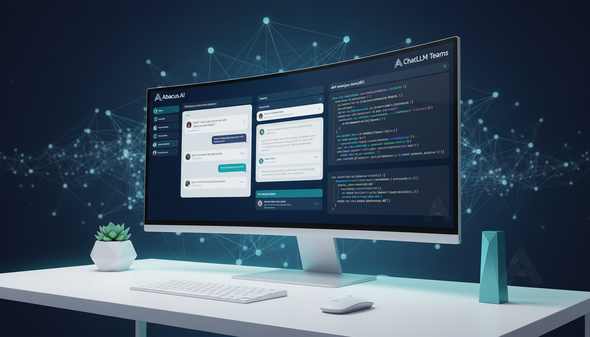
ChatLLM Teams is an Abacus AI product branded as an “AI super assistant.” The key promise is access to top large language models, the primary technology behind the AI super assistant, plus image and video generation tools that highlight its multimodal capabilities, all in a single workspace.
When you first log in, the chat UI looks familiar, close to what most people know from popular ai chatbots driven by natural language processing. The difference is not the layout; it’s what’s sitting behind the model picker. You can switch models quickly, including options like meta ai, or let the system pick one for you.
Chat Features That Matter: Model Choice, Auto-Routing, and “Humanize”
Choose from top models without leaving the chat
Inside ChatLLM, So Tai shows a model selector that includes many of today’s well-known chat options, including:
- GPT-5
- Claude Sonnet 4.5
- Google Gemini 2.5 Pro
- Grok AI 4
The practical perk is speed of comparison. Ask a question once, then regenerate using another model to see which output you prefer.
Route LLM automatically picks the model for your prompt
One feature So Tai calls out as a favorite is Route LLM, which auto-selects the best reasoning model for your prompt from top sources like Claude.
He demonstrates it with two very different prompts:
- “Plan a weekend trip to Paris.” ChatLLM routes this to GPT-5, aiming for a natural, information-rich response.
- “Write a Python script to process data from a CSV file.” ChatLLM switches to Claude Sonnet 4.5, which he describes as the best coding assistant in this test.
This is the kind of feature you don’t notice until you don’t have it. When your workflow involves five tools, half your time can go into choosing the tool, not doing the work.
“Humanize” changes tone, style, and voice
ChatLLM Teams also includes a humanized response option. Instead of rewriting your prompt, you can take an answer you already got and re-style it for human-like responses.
So Tai shows two ways to access it:
- Click More, then select Humanize
- Tap the small human icon below a response
The tone menu includes options such as:
- AI detection bypass
- Professional
- Humorous
- Empathetic
- Concrete
- Custom tone (you type what you want)
He demos it with a simple prompt, “Introduce yourself,” then applies a custom tone: “reply like a YouTuber.” The regenerated response shifts into a more casual, audience-facing style.
For creators, this feature is less about tricks and more about consistency. You can keep the facts, then fit the voice to a script, a post, or a client email.
Built-in Creative Tools: Images, Video, and Voice Models in One Place
ChatLLM Teams is not just chat. So Tai highlights its built-in creative tools for image generation, video, and voice models, supporting versatile content generation.
Image generation models available in ChatLLM Teams
Inside the image tools, he mentions access to several image models, including:
- Cdream
- Midjourney
- Flux One
- Coinedit image
You can run prompts, adjust optional settings, and compare outputs, all without leaving the platform.
Video generation tools (including Sora 2 and KlingAI)
For video, So Tai points out access to newer video models, including:
- Sora 2
- KlingAI (including V3, as shown in the video)
- Luma 2.5
He also notes that video generation takes longer than chat responses, which is expected, but the benefit is being able to test multiple models from the same place.
Voice tools for voiceover work
For voice, ChatLLM includes voice options such as:
- 11 Labs
- OpenAI TTS
- Hume
If you’re used to stitching together a tool like Writesonic for voice and text generation with other platforms such as Jasper AI for creative marketing, seeing everything bundled in ChatLLM Teams as one of the top ChatGPT alternatives can feel like a cost-saving win, with all you need in one drawer.
Deep Agent: The Feature That Changes What “Chat” Can Do
The most important feature in this review is Deep Agent, which So Tai describes as the tool’s standout.
Deep Agent is not just a chatbot that answers questions. It’s positioned as one of the ai agents that can execute multi-step tasks, offering workflow automation by breaking a request into steps and completing the workflow.
You access it from the tools menu on the left side, then you prompt it like you would prompt a chat model.
So Tai shares examples of what Deep Agent can handle:
- Book a restaurant every Thursday night and send an email confirmation (it plans steps, finds options, makes the reservation, sets up the automation, then emails you).
- Create a presentation on the history and development of money (it applies project management to plan complex presentation decks, researching, organizing the topic, gathering info, then generating a complete slide deck).
The point is simple: you ask once, then wait while the agent does the busy work.
Real Tests So Tai Ran Inside ChatLLM Teams
So Tai doesn’t stop at feature lists. He runs several hands-on demos to show the tool under pressure.
PDF analysis: extracting details from a technical paper
First, he uploads a PDF technical paper about “One 2.2 Animate,” described in the video as a method for creating character videos with specific movements.
He tests how well different ai chatbots can read and extract answers.
One example question: “SSIM of One Animate in Table 1.”
ChatLLM auto-selects GPT-5, and So Tai notes that it answers clearly and accurately. Then he regenerates using Claude Sonnet for comparison (and models like Deepseek can be easily compared against others in the workspace), and the result stays strong.
He asks a more technical question next: “Explain face control in the paper.” Again, the response comes back quickly and precisely.
Then he applies a humor tone using Humanize, showing how you can keep the same core answer but shift the vibe.
Image generation test: Midjourney vs Flux Pro
Next, he tests image generation with the prompt:
“A girl holding a sign that says so.”
He starts with Midjourney, keeping settings at default. Since image generation needs time, there’s a short wait. When results return, he says the outputs are solid overall, except for the first image. The other three match the concept well.
Then he switches to Flux Pro. His takeaway: the quality looks lower than Midjourney in this test, with skin that looks overly smooth and plastic.
Video generation test: Luma 2.5 and Sora 2
So Tai then takes the same concept into video.
He tries Luma 2.5 first and tweaks resolution for better output. His result is strong, he says it “absolutely crushed it,” highlighting how ai chatbots streamline such workflows.
Next, he tests Sora 2, calling out that it’s newly released and already integrated into ChatLLM. He pushes it to an 8-second duration, and highlights the quality as “incredible.”
The broader point lands well here: instead of paying for separate tools and bouncing between tabs, you can generate, test, and compare ChatGPT alternatives from one interface.
Deep Agent demo: generating a full marketing video
To show Deep Agent’s ceiling, So Tai prompts it to create a marketing video for his YouTube channel.
Deep Agent builds a task plan that includes:
- Generating character images
- Creating lip-sync videos
- Producing illustrations
- Gathering content about his channel
At the end, it outputs a ready-to-use marketing video that includes lines such as:
“Welcome to SOTAI, state-of-the-art AI, your destination for cutting edge AI education. Get weekly updates on the latest models, master comfy UI workflows, and unlock AI image generation and video animation. We optimize for low VRAM GPUs so everyone can create stunning content from Huan to Flux. We review the newest models. Join our community of over 2,000 subscribers.”
It’s a clear example of what an agent can do when it’s allowed to plan, generate assets, and assemble an output, instead of stopping at text.
ChatLLM Teams Pricing and Compute Points (What $10/month Gets You)
ChatLLM Teams costs $10 per month, a substantial upgrade from the basic free plan, and So Tai explains that the subscription includes 2 million compute points per month, with data security as a key consideration for subscribing users.
A few important notes from the video:
- Compute points reset monthly.
- Compute points are not the same as tokens.
- So Tai says 2 million compute points can translate to 15 million+ input tokens on top models like Claude Sonnet or GPT-4o.
He also shares rough usage estimates based on his experience, noting that heavier tasks eat more points and power high-volume content generation:
- About 500 images per month
- About 50 short videos around 5 seconds each
- About three complex agent tasks per month
For his daily use, he describes this as enough, even as a heavy user who hopes for future Google Workspace integration to boost productivity, and says it saves him close to $100 each month versus separate subscriptions.
Conclusion
If you’re tired of paying for five different tools just to write, code, handle content generation, generate images, and test video models, ChatLLM Teams stands out as a top ChatGPT alternative and among the best chatgpt alternatives to reduce that sprawl. With model choices like Claude, Google Gemini, Claude 3.5 Sonnet, Meta AI, and Grok AI, all emphasizing ethical ai practices and real-time data for pinpoint accuracy, it replaces dedicated research tools. Powered by real-time data, ChatLLM Teams delivers research speeds that surpass traditional search engines and even Perplexity AI, without the need for separate Perplexity AI subscriptions.
The combination of this variety, Route LLM auto-picking, and the Deep Agent workflow automation is what makes it stand out in this review.
Try ChatLLM Teams if you want one workspace for ai chatbots and the jobs that usually push you into separate subscriptions: ChatLLM Teams by Abacus AI signup link used in the review. Then decide what you’d cancel first, extra AI subscriptions like Microsoft Copilot, or the habit of keeping ten tabs open all day while bouncing between search engines.